
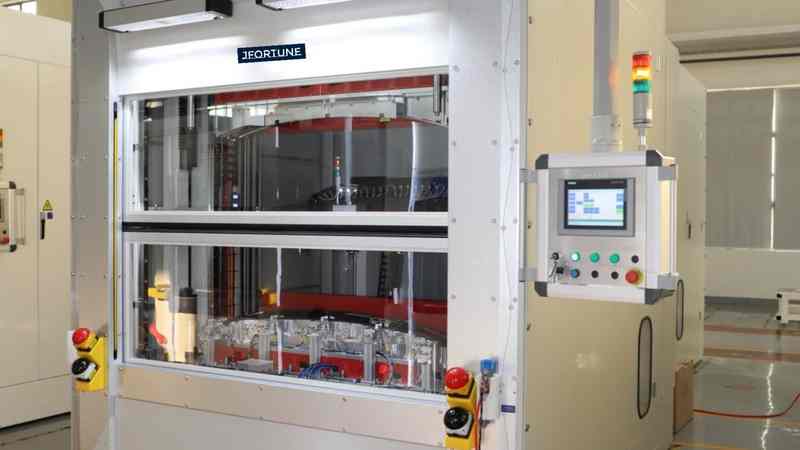
Custom thermoplastic joining systems
Hot Plate Welding Machines Built Around Your Plastic Part
From process evaluation to tooling, automation and factory acceptance testing, Jfortune delivers production-ready hot plate welding systems for demanding plastic assemblies.
Automotive lighting & fluid systems • Plastic pallets • Appliance & industrial housings
Engineering review
What We Evaluate Before Quotation
- Part material and weld-joint geometry
- Product dimensions and annual volume
- Heating, pressure and cooling requirements
- Fixture, controls and automation level
- Quality checks and factory acceptance criteria
Typical response: within 24 hours
Years in plastic welding
Tooling and automation
Safety-focused design
Installation and support
Equipment range
Choose the Right Hot Plate Welding Platform
Machine architecture is selected around part size, weld area, force, cycle time, repeatability and automation needs—not a one-size-fits-all model.
Servo Motor Systems
Hydraulic & Pneumatic Systems
Horizontal & Pallet Systems
Application engineering
Strong, Sealed Joints for Demanding Thermoplastic Parts
Hot plate welding heats both joint surfaces, removes the platen, then joins and cools the parts under controlled pressure. It is especially effective for large weld planes, complex contours and assemblies that require airtight or liquid-tight performance.
- Automotive: lamps, reservoirs, ducts, battery and fluid components
- Logistics: plastic pallets, crates and large structural parts
- Appliances: housings, reservoirs and functional assemblies
- Industrial: filters, tanks and engineered thermoplastic products

Project workflow
From Part Review to Production Acceptance
A clear engineering workflow reduces technical risk before the machine reaches your factory.
01 — Evaluate
02 — Validate
03 — Engineer
04 — Accept

Why Jfortune
A Machine Builder That Stays Involved After Delivery
Your project is supported by mechanical, tooling, controls and service teams working from the same application requirements.
- Custom hot-tool and cold-fixture engineering
- PLC/HMI control and production data options
- Automatic tool-change solutions for flexible production
- Factory acceptance testing with your parts
- Remote troubleshooting, spare parts and training support
Buyer questions
Hot Plate Welding Machine FAQ
Fast answers to the questions that shape machine selection and quotation.
Which plastics can be hot plate welded?
What information is needed for a quotation?
Can the machine and tooling be customized?
How is the machine accepted before shipment?
Start with your part
Send a Drawing. Get an Engineering Recommendation.
Share the material, part size, output target and quality requirements. We will review the application and recommend the next technical step.
ENGINEERING RESOURCES
Hot Plate Welding Guides and Machine Selection
Use these engineering resources to compare materials, motion systems, applications and production configurations.